close
Menu
close
A deep training in insight-oriented changework and the art of helping people see through the illusions behind their suffering.
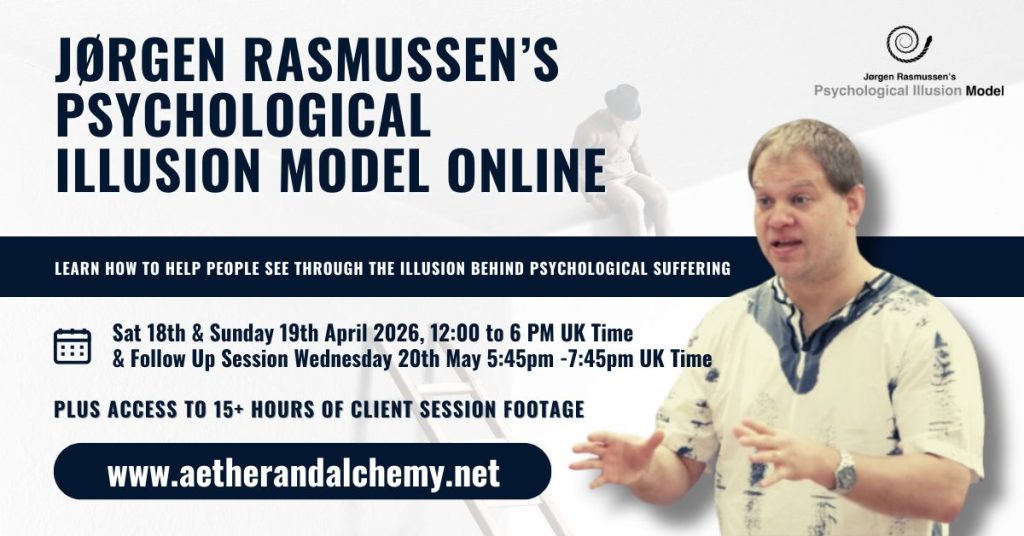
Main Workshop: April 18th and April 19th 2026 12pm -6pm UK time. Follow up session: 20th May 6pm -8pm UK Time. Online Live Training
Imagine walking through the desert.
You see a snake in front of you.
Your heart pounds. Your breath shortens. Your body prepares for danger.
Then you look more closely.
It is not a snake.
It is a rope.
Nothing external changed. Yet everything changed.
Your physiology settles. Your fear disappears. No coping strategy required. No belief to replace. No emotional processing. Just one thing:
You saw clearly.
The Psychological Illusion Model (PIM) is built on this principle.
What we call anxiety, depression, compulsions, phobias, chronic stress, and much psychological suffering can often be understood as variations of seeing a snake where there is a rope, deeply convincing experiences created through thought that appear to be reality itself.
It’s Less About Doing and More About Seeing
Many approaches try to fix the “snake.”
This work helps people realise it is a rope.
When that shift happens, relief can follow naturally not because something was controlled, but because something was understood.
Watch Jørgen discuss the PIM Workshop
Jørgen Rasmussen shares his methods of effective therapeutic change and how to become a more effective agent of change and in this workshop you will:
Drawing on over 25 years of therapeutic practice, Jørgen shares his approach to therapeutic change and his experiences working with difficult or ‘impossible’ clients. This has resulted in him simplifying his approach and going back to the first principles of change. This has led him to develop what he terms the ‘psychological illusion model’ of change work. He also shares his discovery about how many therapists can become more effective by getting out of their own way.
This training is not about adding more tools to your toolkit.
It is not about scripts, step-by-step methods, or treatment formats.
Instead, this work orients around:
Rather than trying to change thoughts, manage emotions, or fix behaviour, this approach explores how experience itself is constructed and how suffering often dissolves when the illusion behind it is seen.
The Practitioner’s Role Changes
You are not: forcing, correcting, or managing symptoms.
You are helping create the conditions where clients begin to see how experience is being constructed moment-to-moment.
The change comes from their insight, not your intervention.
Many of us have watched a magician perform a trick and felt slightly foolish afterwards.
We know it is an illusion
But while watching, it feels completely real.
All our attempts to figure out how the trick works only make us more confused because our solutions are based on the same blind spot that allows the illusion to work.
Psychological suffering often functions like this.
People can become absorbed in imagined worst-case scenarios and experience real anxiety.
They can become absorbed in “I’m worthless” and feel depression.
They can become absorbed in “this pain means something is seriously wrong” and magnify chronic suffering.
It is not that they are broken.
It is that they are caught in a psychological magic trick.
This training is like being invited backstage with the magician.
Through stories, demonstrations, and practical experiments, participants explore the mechanisms behind these illusions and learn how to help clients discover this for themselves.
Not by convincing them. Not by correcting them. But by helping them see.
Hypnosis can be described as becoming fully absorbed in an imagined reality.
But people often do this already.
Absorbed in imagined futures.
Absorbed in self-judgements.
Absorbed in catastrophic interpretations.
The Psychological Illusion Model explores how practitioners can create the conditions where clients begin to recognise how they have been “self-hypnotising” through thought and how this recognition itself changes their relationship with experience.
The practitioner’s role is not to fix, persuade, or override. It is to guide attention toward insight.
Jørgen describes four levels at which change work can operate:
This workshop focuses on the fourth level where shifts often occur naturally as perception changes.
This is an experiential learning environment. The teaching includes:
The aim is to help practitioners develop the sensitivity, presence, and artistry required to support insight-based change.
It Develops Change Artistry, Not Technique Accumulation
Rather than learning more methods, you develop:
• Sensitivity to psychological illusion
• Skill in framing and context creation
• Greater presence and psychological freedom as a practitioner
• The ability to work fluidly rather than mechanically
Participants receive access to 15+ hours of recorded real client sessions followed over time. These include work with:
These recordings provide a rare opportunity to observe how this model functions in real-world contexts.
An important part of the training explores something often overlooked:
The therapist’s internal state.
Many practitioners unknowingly divide attention between the client and maintaining their own self-image, managing insecurities, or trying to “get it right.” This consumes bandwidth and can reduce effectiveness.
This workshop explores how to reduce these tendencies and work from greater presence, flow, and psychological freedom.
The Psychological Illusion Model has developed through decades of client work and draws on influences including:
Jørgen continues refining the model through ongoing practice and teaching, and this training presents his most current thinking.
This workshop is suited to:
It is particularly relevant for those who feel drawn toward insight-oriented, principle-based work.
This Live Online Training includes:
Book using the form at the foot of this page.
Previous PIM participants can attend for an update and refresh at a discounted rate of £180. Also if you have attended before and you refer someone new to PIM who books on, your place is free. Contact info@aetherandalchemy.net if this is of interest.

Jørgen has worked professionally as an agent of change for over twenty years. He is the author of the books “Provocative Hypnosis” and “Provocative Suggestions” which have been widely acclaimed. Jørgen’s work draws on a number of influences including: hypnosis, NLP, meditation and eastern and western approaches to psychology. He is also an experienced self defence instructor.