
close
Menu
close
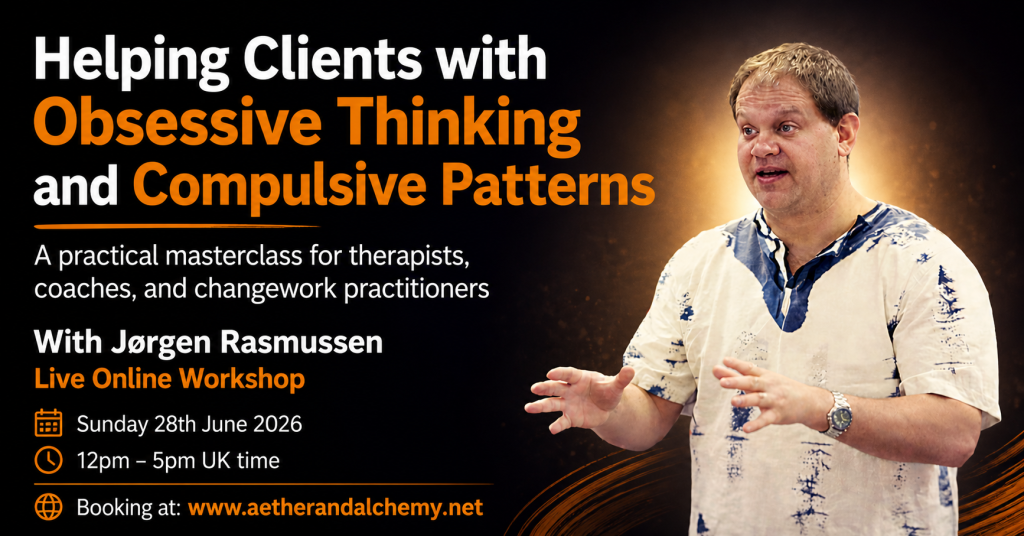
With Jørgen Rasmussen
A practical training for therapists, coaches, and changework practitioners
What if the very effort to help clients overcome compulsive thoughts is, in subtle ways, part of what keeps those thoughts in place?
Many practitioners are trained to help clients manage, challenge, or reframe their thinking. It sounds sensible. It often feels helpful in the moment.
And yet, with compulsive thinking, something different tends to happen.
With clients who experience obsessive thoughts or compulsive behaviours, the usual approaches can backfire.
Trying to control thoughts can make them feel more significant.
Trying to manage anxiety can reinforce the sense that something is wrong.
Even well-intentioned coping strategies can strengthen the very patterns they aim to resolve.
Over time, both practitioner and client can find themselves working harder without things truly shifting.
This is one reason many experienced practitioners quietly admit that they find this area challenging.
Jørgen writes:
“I have a confession: I used to dread working with clients who struggled with compulsive thoughts and rituals. And having mentored therapists and coaches for many years, I have discovered that this had been the case for them as well.
And there is a reason for that. Most approaches attempt to help the client change, manage or control either WHAT they think or HOW they think, but this often backfires as it adds even more thinking and helps mark out the thoughts as even more important. The outcome usually being that the solutions end up maintaining the problem. This is also the case with the safety rituals that people develop in an attempt to cope. They tend to reinforce the sense of threat.
What is needed is a radically different relationship to one’s thoughts and feelings.
For those who struggle with compulsive thoughts it seems as if the thoughts themselves have some sort of inherent power. An inherent power to make them act, feel, or to worry, ruminate or become hypervigilant.
It looks as if the thoughts and feelings come with a command or urge to compel behaviours and subsequent thoughts and feelings
But this is an illusion. It only seems that way. But it’s of no use to someone that it’s an illusion until they discover for themselves in an embodied way the illusory nature of thinking.
This seminar is designed to help clients see through this illusion and offers practical frameworks and strategies from the psychological illusion model as well as behavioural interventions”
You might have seen clients who:
• feel driven by thoughts that seem to carry a kind of urgency or command
• develop rituals or mental strategies to try to neutralise discomfort
• understand, intellectually, that their fears are irrational, yet still feel compelled to act
• make progress in sessions, only to find the patterns returning in daily life
And you may have noticed that the more you try to help them deal with the thoughts, the more central those thoughts seem to become.
In addition, Jorgen notes that hypnotherapists can often find these clients challenging as their busy minds often make hypnotic work more difficult.
What if the sense of compulsion is not coming from the thoughts themselves?
What if it only appears that way?
From the perspective of the Psychological Illusion Model, the power of compulsive thinking is not inherent. It is perceived.
Thoughts can seem to carry urgency, meaning, and force.
But that sense of force is created in the moment.
For many clients, there is a kind of “thought fusion”, where it looks as if certain thoughts have the power to compel action, create emotion, or pull them into rumination or hypervigilance.
But what if that power is only appearing to be there?
Until this is seen clearly, it feels real.
Once it is seen through, something fundamental shifts.
It is not enough for someone to be told that thoughts have no inherent power. The shift happens when they discover this for themselves, in a direct and embodied way.
Jørgen gives a simple example from his work:
A young man who was about to join the army struggled with stuttering.
It seemed as though certain letters, like “T” or “K”, had the power to make him stutter.
Every time he approached those words, the problem would appear.
But of course, no letter has any inherent power.
Through a series of simple experiments, he was able to see this for himself.
And as that understanding shifted, so did the pattern.
This same mechanism shows up in many different forms.
With certain thoughts
With specific situations
With particular sensations or triggers
It can look as though something external or internal has the power to compel a response.
But what if that power is only appearing to be there?
You may find it useful to hear Jørgen explain this in his own words.
In this short video, he shares a simple example that illustrates the core idea behind this approach.
The Helping OCD Clients Masterclass is designed to give you a practical, experience-based understanding of how to work with compulsive thinking in a different way.
What is needed is not more tools to change what someone thinks or how they think, but a way to guide them to a fundamentally different relationship to their thoughts and feelings.
Rather than adding more strategies on top of the problem, this training helps you guide clients towards seeing through the mechanism that creates it.
This is a hands-on, practitioner-focused training. You will:
Most approaches focus on changing thoughts or managing reactions.
This work takes a different direction.
It does not try to fight or fix thinking.
It helps clients see what thinking is and how it functions.
From that shift, change happens more naturally.
You are not applying techniques to the content of the problem.
You are helping clients see the nature of the process itself.
One of the challenges in this area is that clients can even become “compulsed” around the techniques intended to help them.
This is one reason why adding more tools is not always the answer.
For many practitioners, this represents a shift in identity as much as skillset.
From someone who manages problems to someone who facilitates insight.
This workshop is for you if:
• you are a therapist, coach, hypnotherapist, or changework practitioner
• you already work with clients and are comfortable guiding change processes
• you are open to mindbody perspectives and experiential learning
• you are interested in working beyond the limits of purely technique-driven approaches
It may not be the right fit if:
• you are looking for a strictly medical or protocol-based framework
• if you are just looking for a new tool in your toolbox and are tied to the framework you operate from. This is about guiding someone to have a different relationship to their experience.
• you prefer rigid, step-by-step methods with little flexibility
Jørgen Rasmussen has worked professionally as an agent of change for over thirty years.
He is the author of Provocative Hypnosis and Provocative Suggestions, both widely respected in the field. John Grinder (co-creator of NLP) says of his work… “This is the stuff of genius”.
His work integrates hypnosis, NLP, meditation, and both Eastern and Western psychological approaches.
He is also the originator of the Psychological Illusion Model, a framework that explores how experience is created and how insight leads to meaningful change.
Format: Live online via Zoom
Date: Sunday 28th June 2026
Time: 12pm to 5pm UK time
You do not need prior training in the Psychological Illusion Model to benefit from this workshop.
If you have ever felt that working with compulsive thinking requires something deeper than more tools or techniques, this training may offer a useful shift. If this speaks to how you want to work, you are welcome to join us.
Practitioners who train with Jørgen often describe a shift that goes beyond learning new techniques. It changes how they understand their work, and how they show up with clients.
Here is a sample of what people have said after attending his trainings:
“I will never look at change work the same way again.”
The Psychological Illusion Model has fundamentally changed how I work with clients. It’s a real game changer.
Johan
“What I experienced was truly life-changing.”
Jørgen’s work goes far beyond the intellect. His commitment to the model and the depth behind it is evident throughout.
Natasha, Clinical Psychologist
“I use this work every day with clients and achieve amazing results.”
Since starting with this approach, my practice has grown through word of mouth alone.
Peter Jakobsen, Hypnotherapist and Metacognitive Therapist
“It expanded my thinking and raised my level of change work.”
I gained practical insight into how to get better results with clients, and now feel confident applying it.
Linda Szabo
“A game changer in how I approach complex client issues.”
Clear, practical, and immediately applicable. It opened up entirely new possibilities in my work.
Thomas Wood

Jørgen has worked professionally as an agent of change for over twenty years. He is the author of the books “Provocative Hypnosis” and “Provocative Suggestions” which have been widely acclaimed. Jørgen’s work draws on a number of influences including: hypnosis, NLP, meditation and eastern and western approaches to psychology. He is also an experienced self defence instructor.