close
Menu
close
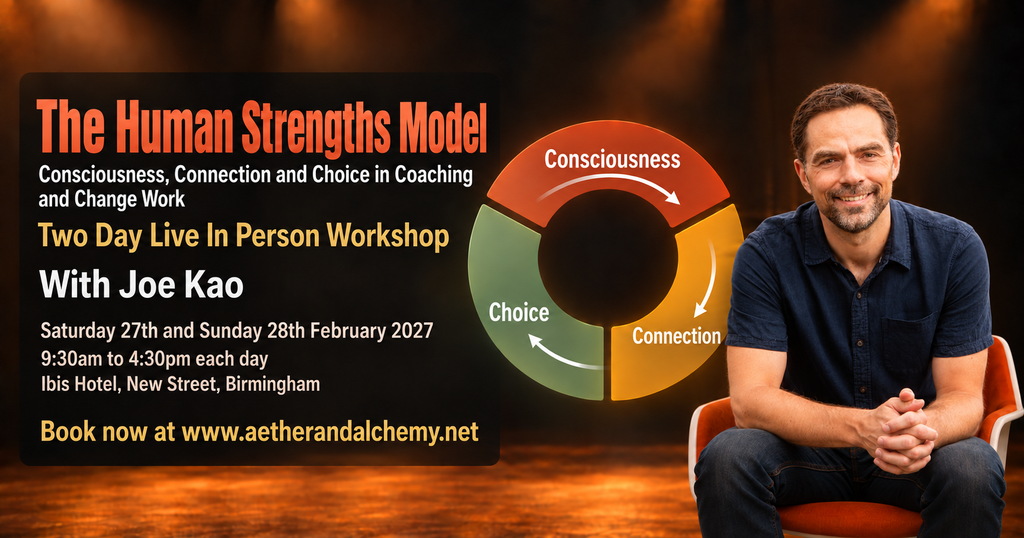
A Live, In Person Workshop with Joe Kao
For coaches, therapists, personal development practitioners and professional communicators
Saturday 27th and Sunday 28th February 2027, 9:30am to 4:30pm each day. Ibis Hotel, New Street, Birmingham
Join Joe Kao Live and In Person and Discover the Human Strengths Behind Effective Changework
When it comes to coaching and therapy, many people become fixated on techniques, scripts and procedures.
But the truth is that how you communicate, how you relate to the client, and the quality of attention you bring, is the difference that makes the difference.
A suggestion offered at the wrong moment, in the wrong tone of voice, can bounce off, like a scene in a film that just doesn't ring true. But when the connection is there, and the timing is right, those same words can be life changing.
It's easy to assume this is simply a matter of practice and experience, that if you work with enough clients you'll eventually get there. Perhaps. But practice and experience can just as easily make people fossilise: stuck repeating the same techniques, in the same tone of voice, for years or even decades.
This new workshop with Joe Kao offers a different approach: a complete system for learning these skills directly, so you can put them to work in your sessions straight away, and keep refining them long after the workshop ends.
So what actually makes the difference?
Joe's answer is simple, and a little surprising: it's the things that make us human.
“In working with clients over the last two decades, I’ve found that the key to effective changework isn't about rigid techniques or memorising scripts. It's what happens between two people when there is genuine understanding and connection. At a time when anyone can get a fluent, articulate answer from a machine in seconds, I think that matters more than ever. Our role as coaches is not to be robots. We are there to be present, to really listen and to create powerful, positive experiences that lead to transformation.”
Joe Kao
Joe has called his approach The Human Strengths Model, because it's about drawing on your natural human strengths, and helping your clients to do the same.
These aren't strengths you need to acquire. Everyone has them. But training, habit and years of following procedures can bury them. The weekend is about bringing them back to the surface, where you can use them on purpose.
And in an age when a chatbot can produce a fluent answer to almost any question, it has never been more worth understanding what a client gets from sitting with another human being.
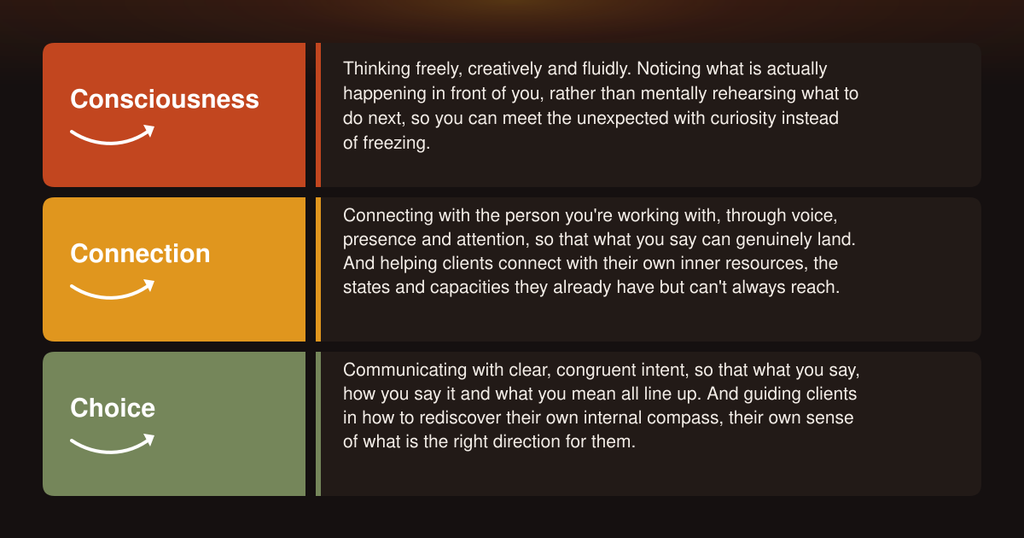
The model rests on three core domains:
Watch Joe discuss the Human Strengths Model
A dojo is a place of practice. You don't learn a martial art by taking notes, and the same is true of the skills that make changework come alive.
In the Changework Dojo you won't simply learn about the Human Strengths Model. You'll practise it: through focused exercises, experimentation, feedback and repetition, until responding well in the moment feels natural rather than effortful.
We'll draw on the same methods that improvisers, actors and voice artists use to respond in the moment, trust their intuition and express themselves freely. We'll also bring in principles from mindfulness, bodywork and the martial arts, invaluable for staying present, clear headed and resourceful, whatever issue you're working with.
Expect plenty of movement and interaction, and very little sitting and listening. Across the two days you'll work through:
Each of these strengths makes a difference at every stage of a session, from the moment you first sit down with a client, through to the moment of breakthrough:
Improvisers are trained to listen closely, accept what's offered and build on it, rather than forcing a prepared script. Actors and voice artists know how to make words ring true. Martial artists learn to stay grounded, balanced and clear headed under pressure, and to use no more force than the moment needs.
Every one of those is a changework skill. None of this is about being funny, performing or becoming an actor. It's about borrowing what these disciplines already know about being fully human in the moment.
You don't need any experience of improvisation, acting or martial arts. The exercises are introduced gradually and designed to build attention and responsiveness, not to test your ability to perform or entertain.
Most of the work happens in pairs and small groups rather than in front of the whole room. Nobody is asked to perform for an audience, and personal disclosure is always your choice. If you're quieter or a little nervous about the idea of improv, you're very welcome: many people find those are exactly the qualities that make the exercises most valuable.
You'll come away with a clear, memorable framework, the Human Strengths Model, that you can bring to any approach you already use. It doesn't replace your existing training. It sharpens how you deliver it.
You'll also leave with a set of exercises you can keep practising on your own and with colleagues long after the weekend. Like any skill learned in a dojo, these strengths grow with practice, so the workshop is the beginning of the work rather than the end of it.
Joe has run related material online before, always to great reviews, but this is the first time this particular workshop has been offered live and in person.
Working together in the room opens up a level of interaction that's hard to reach over a screen: partner exercises, group games, and the kind of shared energy that only comes from being in the same physical space.
Joe has taught related material to coaches and therapists before, in online courses drawing on improvisation, storytelling and hypnotic language. Here's what past participants said about that work:
“It was easily the most fun I have had at a workshop and one of the most personally beneficial. I not only had a great time practicing in the breakout rooms provided, but I also brought the exercises into my personal life.”
Ron Gonsalves, Boston, MA, USA
“I found the improv and therapy course extremely enjoyable and I learned so much. There was a fascinating blend of theory, explanation and exploration, learning by doing. I felt I was being thrown into the deep end but in a safe and supportive environment. And by the end of the course, I was beginning to swim. Joe talks about improv with passion and a huge amount of experience. He teaches in a highly interactive way, with energy enhancing improv drills and exercises. It's wonderful to be learning so much useful stuff and having a load of fun at the same time. I came away buzzing with ideas and feeling far more in the moment than before.”
Michael Shoolbred
Joe Kao DHypPsych(UK) is a hypnotherapist and psychotherapist in Cambridge, UK, and the first official trainer of Provocative Change Works. He is also head writer for hypnosisdownloads.com, one of the world's largest and most highly regarded websites for hypnosis recordings.
Joe has taught workshops on therapeutic metaphors, storytelling and Ericksonian hypnosis to practitioners around the world, including Precision Hypnosis, The Storyteller Within and Socratic Questioning. But his real fascination lies in what happens beneath the technique: how presence, connection and clear intent make the difference between an intervention that lands and one that doesn't.
He has trained extensively in improv theatre, voice work and performance skills, and brings a further grounding in martial arts principles. The Human Strengths Model brings all of these together into a single framework for practitioners, and this workshop is the first opportunity to train in it live and in person.
Places on this workshop are limited, so that everyone gets plenty of hands-on practice and personal attention. The early rate is £275 (full price £360), and you can secure your place with a £75 deposit. To secure your place for the weekend in Birmingham, book using the form below.
We look forward to seeing you in the Dojo.
Do I need any experience of improvisation or acting?
None at all. The exercises start simply and build gradually, and they're designed to develop attention and responsiveness, not performance skills.
Will I have to perform in front of the whole group?
Most of the work will be in pairs and small groups, and this will be a no-pressure environment. The nature of improv isn’t about trying to be good, clever or funny. It’s about embracing whatever happens and building on it.
Is this only relevant to hypnotherapists?
Not at all. The Human Strengths Model applies to any approach where you work with people in real time: coaching, therapy, counselling, NLP, training and facilitation.
Will we be practising change work on one another?
There will be short pieces of change work practice, and you always choose what you bring to them.
Is the workshop physically demanding?
There will be some movement exercises, but nothing strenuous, and exercises can be adapted according to your physical ability.