close
Menu
close
Discover the most unusual but most effective strategy for effective change work

Register interest using the form on this page to get updates about discounts and booking.
A Two-Day Live Online Workshop, 23rd and 24th January 2027, 1pm to 5pm UK Time
Preserving the protocol, delivering the practice. The Swan continues. A new voice, the same power.
For years, Bob Burns has been the name behind the Swan Protocol, a technique now used by therapists in more than 85 countries to make instant contact with the subconscious in a fully waking state.
Bob has now stepped back from teaching. He has not stepped back from the Swan.
He has personally handed the work on to Derek Heron, the practitioner he chose to carry it forward. Derek has worked with the Swan extensively in his own practice, and this January he is running his first full masterclass as its new trainer, bringing his own depth, his own teaching style, and a renewed focus.
The Swan works with clients in a fully waking state, with no formal trance induction needed, making instant, direct contact with the subconscious.
It can stand entirely on its own as a complete change work approach, or be woven in alongside hypnosis and other techniques you already use. Many practitioners now treat it as their go-to protocol, the first thing they reach for with almost any client. Others keep it in reserve and turn to it specifically when other approaches have stalled, finding it opens a door nothing else could.
This workshop also goes into self-swanning, using the technique on yourself, and into how to elicit and work with direct voice responses using The Swan Protocol.
Alongside the Swan itself, this workshop teaches a failsafe consultation framework, known as the Wall. It is a structured template for the initial client consultation that covers the bases many therapists worry about missing: building trust quickly, screening appropriately, and setting a client up to succeed before the real work even begins.
Walking into a session already knowing your consultation has you covered is, for many practitioners, one of the single biggest confidence boosts this workshop provides.
Derek, a published author and recognised expert in rapport and body language, will share his approach to building genuine rapport with both the conscious and unconscious minds of a client. This isn't just a nice-to-have skill sitting alongside the Swan, it's the foundation the rest of the work is built on. Getting rapport right from the outset gives you a real head start in the therapy room, setting the stage for smoother sessions and better outcomes across everything that follows.
Day One: Foundations
Day Two: Practice and Depth
If you have done a Swan workshop before, whether with Bob or otherwise, you are welcome to return at a reduced refresher rate.
The core of the protocol has not changed, but how it is taught has. Derek brings his own teaching style and his own emphasis, particularly on rapport, direct voice, and troubleshooting, and many practitioners find that revisiting the Swan with a different teacher, and a few more years of practice behind them, is exactly what makes it finally click.
Practitioners with some hypnotherapy background who want to develop confidence with the Swan Protocol, whether that means learning it as a stand-alone go-to approach, adding it alongside techniques you already use, or keeping it in reserve for the clients other methods have not reached. Suitable both for those completely new to the Swan and for those who have trained before and want to go deeper, particularly into direct voice, self-swanning, and real-world troubleshooting.
Register your interest using the form below. We will let you know when booking is open and any early booking bonuses.
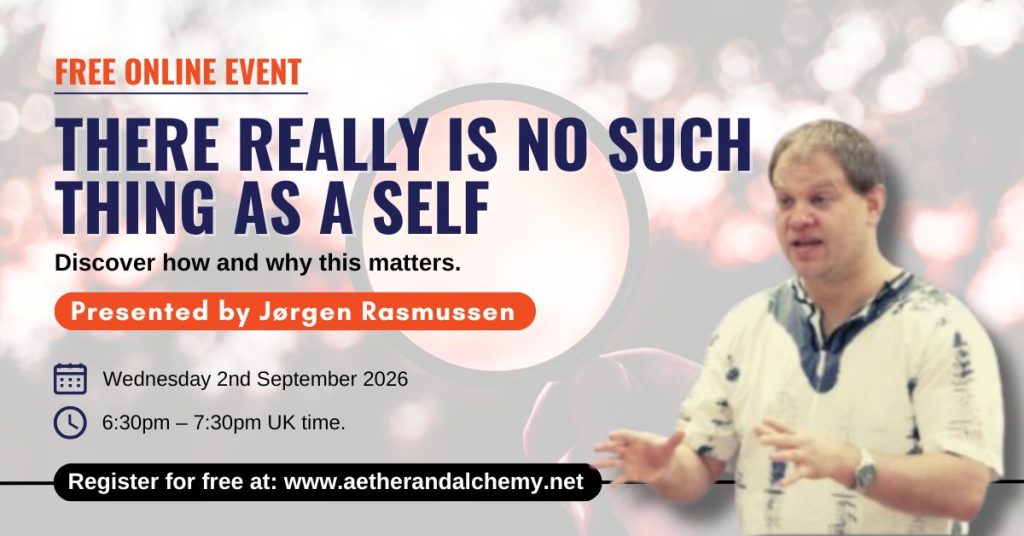
Join expert change worker Jørgen Rasmussen and find out about this radical idea and how getting this insight can benefit you.
Register for free at the link below:
https://aetherandalchemy.aweb.page/no-such-thing-as-a-self-26
Wednesday 2nd September 2026 6:30PM -7:30PM (UK Time)
What if most of your mental chatter - your worries, goals, doubts, and even your self-improvement efforts were all in service of a psychological illusion?
Join changework expert Jørgen Rasmussen for this free live session as he introduces a radical but increasingly explored idea:
There is no such thing as a fixed, stable self.
Jørgen will share real examples from decades of client work, including a case where a man's lifelong shame turned out to belong to someone who'd never actually existed, and how a moment of total inner silence permanently changed one woman's relationship to her own thinking. You'll also be invited to engage in a thought experiment exploring how many different “versions of you” exist only in other people's minds, and why none of them are actually you.
In this mind-opening session, you’ll explore:
✅ Why the idea of “the self” might be one of the most widespread and limiting assumptions of our culture
✅ The surprising psychological and ethical implications of this illusion
✅ How this topic relates to personal freedom, suffering, and the way we relate to others
✅ Why an embodied realisation (not just an intellectual understanding) of this illusion can be a profound turning point.
Whether you’re a coach, therapist, someone into personal development, or simply someone curious about what lies beneath the surface of identity, this free session offers a powerful invitation to look more deeply.
This event will also introduce the themes behind Jørgen’s upcoming 9-part experiential masterclass, but you don’t need to be planning to attend that to benefit from this evening.
Come with an open mind, leave with a fresh perspective.
REGISTER FOR FREE USING THE FORM AT THE LINK BELOW
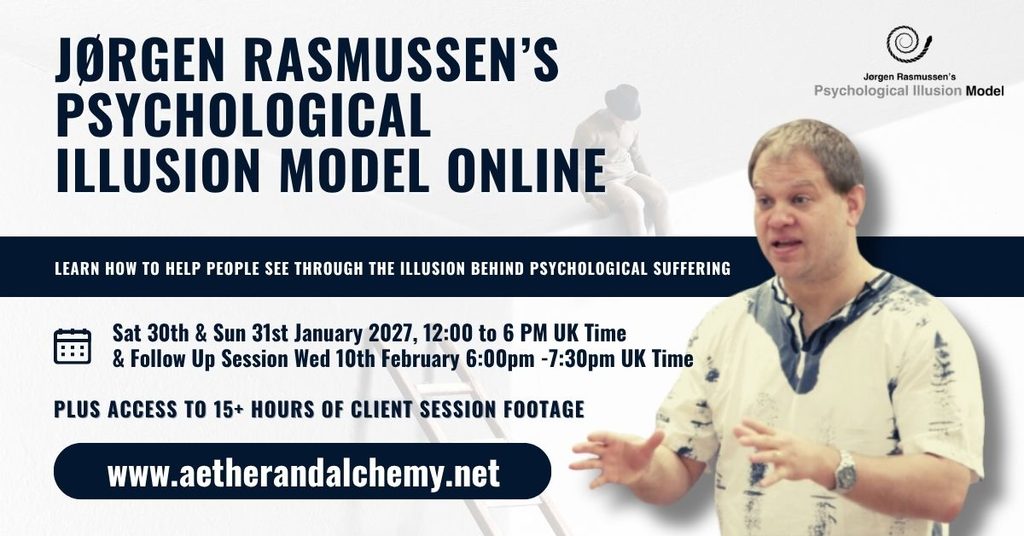
Super Early Booking Rate Available Now
Main Workshop: 30th and 31st January 2027, 12pm–6pm UK time. Optional Follow-up Q and A session: Wednesday 10th February 2027, 6:00pm–7:30pm UK time. Online Live Training.
Imagine walking through the desert.
You see a snake in front of you.
Your heart pounds. Your breath shortens.
Your body prepares for danger.
Then you look more closely.
It is not a snake. It is a rope.
Nothing external changed. Yet everything changed.
Your physiology settles. Your fear disappears. No coping strategy required. No belief to replace. No emotional processing. Just one thing:
You saw clearly.
The Psychological Illusion Model (PIM) is built on this principle.
What we call anxiety, depression, compulsions, phobias, chronic stress, and much psychological suffering can often be understood as variations of seeing a snake where there is a rope, deeply convincing experiences created through thought that appear to be reality itself.
Many approaches try to fix the “snake.”
This work helps people realise it is a rope.
When that shift happens, relief can follow naturally, not because something was controlled, but because something was understood.
Jørgen Rasmussen shares his methods of effective therapeutic change and how to become a more effective agent of change, and in this workshop you will:
Drawing on over 25 years of therapeutic practice, Jørgen shares his approach to therapeutic change and his experiences working with difficult or ‘impossible’ clients. This has resulted in him simplifying his approach and going back to the first principles of change. This has led him to develop what he terms the ‘psychological illusion model’ of change work. He also shares his discovery about how many therapists can become more effective by getting out of their own way.
This training is not about adding more tools to your toolkit.
It is not about scripts, step-by-step methods, or treatment formats.
Instead, this work orients around:
Rather than trying to change thoughts, manage emotions, or fix behaviour, this approach explores how experience itself is constructed and how suffering often dissolves when the illusion behind it is seen.
You are not: forcing, correcting, or managing symptoms.
You are helping create the conditions where clients begin to see how experience is being constructed moment-to-moment.
The change comes from their insight, not your intervention.
Many of us have watched a magician perform a trick and felt slightly foolish afterwards.
We know it is an illusion.
But while watching, it feels completely real.
All our attempts to figure out how the trick works only make us more confused because our solutions are based on the same blind spot that allows the illusion to work.
Psychological suffering often functions like this.
People can become absorbed in imagined worst-case scenarios and experience real anxiety.
They can become absorbed in “I'm worthless” and feel depression.
They can become absorbed in “this pain means something is seriously wrong” and magnify chronic suffering.
It is not that they are broken.
It is that they are caught in a psychological magic trick.
This training is like being invited backstage with the magician.
Through stories, demonstrations, and practical experiments, participants explore the mechanisms behind these illusions and learn how to help clients discover this for themselves.
Not by convincing them. Not by correcting them. But by helping them see.
Hypnosis can be described as becoming fully absorbed in an imagined reality.
But people often do this already.
Absorbed in imagined futures.
Absorbed in self-judgements.
Absorbed in catastrophic interpretations.
The Psychological Illusion Model explores how practitioners can create the conditions where clients begin to recognise how they have been “self-hypnotising” through thought, and how this recognition itself changes their relationship with experience.
The practitioner's role is not to fix, persuade, or override. It is to guide attention toward insight.
Jørgen describes four levels at which change work can operate:
This workshop focuses on the fourth level, where shifts often occur naturally as perception changes.
This is an experiential learning environment. The teaching includes:
The aim is to help practitioners develop the sensitivity, presence, and artistry required to support insight-based change.
Rather than learning more methods, you develop:
Participants receive access to 15+ hours of recorded real client sessions, followed over time. These include work with:
These recordings provide a rare opportunity to observe how this model functions in real-world contexts.
An important part of the training explores something often overlooked: the therapist's internal state.
Many practitioners unknowingly divide attention between the client and maintaining their own self-image, managing insecurities, or trying to “get it right.” This consumes bandwidth and can reduce effectiveness.
This workshop explores how to reduce these tendencies and work from greater presence, flow, and psychological freedom.
The Psychological Illusion Model has developed through decades of client work and draws on influences including:
Jørgen continues refining the model through ongoing practice and teaching, and this training presents his most current thinking.
This workshop is suited to:
It is particularly relevant for those who feel drawn toward insight-oriented, principle-based work.
In 2027, Jørgen will be launching a year-long PIM Deep Dive Development Group, meeting monthly for continued practice and refinement of this work.
Attendance at this training, or a previous PIM workshop, will be a prerequisite for joining the PIM Deep Dive Development Group. If you're considering the Deep Dive group, this is your opportunity to complete that prerequisite. Further details on the Deep Dive group will follow in due course.
This Live Online Training includes:
Book using the form at the foot of this page.
Previous PIM participants can attend for an update and refresh at a discounted rate of £190. Also, if you have attended before and you refer someone new to PIM who books on, your place is free. Contact info@aetherandalchemy.net if this is of interest.
"I'm looking forward to studying Jørgen's work again, again, and again. I use his work every day with clients and achieve amazing results. Since starting to work with PIM, I don't advertise anymore; I get all my clients through word of mouth. I will be studying everything thoroughly. I highly recommend anyone working with people to study PIM”
Peter Jakobsen. Hypnotherapist and Metacognitve Therapist and a PIM-ist
“It was Jørgen's books, which I discovered by accident, that sparked my desire to discover more. I signed up for his weekend seminar in search of personal transformation techniques that were different and outside the box, in order to resolve myself and others. But what I discovered was quite extraordinary. My experience was truly life-changing, embodying a knowledge that goes far beyond the intellect. Jørgen's commitment to this model, which he has created throughout his practice, is evident. The stories he introduces are countless and each one has a real purpose. I recommend this experience in Aether and Alchemy without any hesitation".
Natasha Gallo, Clinical Psychologist
"Anyone serious about leading their clients towards meaningful and lasting change should consider training with Jørgen Rasmussen. And it goes without saying that Pete Dalton is hosting one of the best platforms for change workers through Aether and Alchemy, making it an excellent resource for professionals in the field".
Thomas Wood
“The stand-out lecture for me was that of Jørgen Rasmussen. He shared some of his unique techniques and latest ideas coloured by insights from years of meditation. I clapped, nodded and every now and again tried in vain to hold the two sides of my head together as one. This was a dance with the unchanging, a trip into timelessness and one that I believe is going to rip through the industry and therapy as a whole in the years ahead”.
-Anthony Jacquin (commenting on Jørgen’s presentation at the UK Hypnosis Convention)
‘….this is the stuff of genius’
-John Grinder Co Creator of NLP
Jørgen has worked professionally as an agent of change for over thirty years. He is the author of the books “Provocative Hypnosis” and “Provocative Suggestions” which have been widely acclaimed. John Grinder (co-creator of NLP) says of his work… “this is the stuff of genius”. For years, Jørgen has been running what he describes as an ‘impossibles practice’. What he will teach in this workshop demonstrates how he has subsequently refined and simplified his approach over the intervening years, so that it is simpler and more effective and more transferable to other contexts.
Jørgen’s work draws on a number of influences including: hypnosis, NLP, meditation and eastern and western approaches to psychology. He is also an experienced self defence instructor.
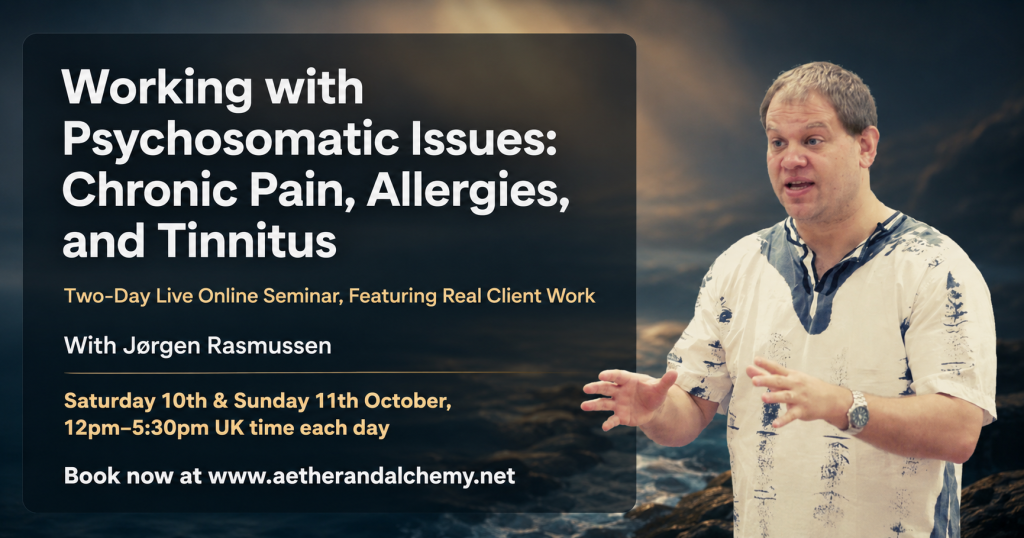
Early Booking Rate Available
Imagine walking along and seeing what looks like a snake.
Your heart races. Your muscles tense. Fear floods your body.
Then you look again, and realise it's a rope.
Nothing outside you has changed, but everything about your experience has.
This workshop explores what happens when that same principle is applied to three of the most common, and most misunderstood, issues practitioners encounter: chronic pain, allergic responses, and tinnitus.
Jørgen writes:
"After nearly thirty years of client work, I've come to see these three issues as variations on the same theme. In each case, the body is reacting to a threat that isn't really there, a prediction gone wrong, not a pathology. And in each case, once someone can update that prediction, the whole loop can change.
None of this replaces medical care. But for a great many clients who have already ruled out or addressed the medical picture, there is a different door in."
Chronic pain, allergic responses, and tinnitus can look like entirely separate problems. In practice, they often share the same underlying loop: the mind interprets a neutral signal as dangerous, the body responds as if under threat, and that response itself becomes further evidence that something is wrong. Anxiety and symptom feed each other, and the cycle continues, sometimes for decades.
This two-day seminar explores that shared mechanism in depth, then applies it specifically to each of the three issues, with a real client volunteering to work with Jørgen live on each one.
Chronic Pain. Most chronic pain, including back, neck, shoulder, and knee pain, fibromyalgia, chronic fatigue, TMJ, and migraines, persists not because of ongoing tissue damage but because the brain has learned to predict danger. The same brain areas involved in producing chronic pain are largely the ones involved in constructing chronic pain. You'll learn how to help clients update that prediction, illustrated with real cases including phantom limb pain and a well-known case of pain that vanished the instant a perceived injury turned out not to exist.
Chronic Pain. Most chronic pain, including back, neck, shoulder, knee, and foot pain, fibromyalgia, chronic fatigue, TMJ, carpal tunnel syndrome, and migraines, persists not because of ongoing tissue damage but because the brain has learned to predict danger. This is what's known as neuroplastic pain: the same brain areas involved in producing chronic pain are largely the ones involved in constructing chronic pain. You'll learn how to help clients update that prediction, illustrated with real cases including phantom limb pain and a well-known case of pain that vanished the instant a perceived injury turned out not to exist.
Allergic Responses. An allergy can be understood as a kind of phobia of the immune system, a false alarm, a threat detected where there isn't one. The immune system has passive responses built for things that aren't really dangerous, and active responses built for genuine threats, like a virus. In an allergic response, the mind-body system misfiles something harmless, a cat, pollen, garlic, into the "active threat" category, and the body responds accordingly.
Jørgen has seen this play out in some striking ways. In one case, a client had become severely allergic to her own cats, animals she loved deeply. Investigation traced the response back to an association she hadn't consciously made: imagining the cats brought up a feeling of unconditional love, and that feeling had become linked to the loss of her husband. Once she saw the connection, the allergy resolved. In another, more recent case, a client who'd suffered a decade of severe IBS-type symptoms whenever she ate garlic is now eating it freely again, with the underlying prediction, not the garlic itself, having been the problem all along.
You'll learn a practical framework for helping clients shift an allergic response, how to frame these sessions, and how to troubleshoot when a client doesn't respond as expected.
Tinnitus. Standard approaches (hypnotic regression, suggesting the sound away, negotiating with "parts" of the mind) rarely work reliably with tinnitus. While it is acknowledged that tinnitus may have to do with pathology at times, however it often does not. What often does help is addressing the psychological loop that keeps the sound front and centre, reducing both its intensity and how much it torments the client.
Humans have a remarkable capacity to habituate to sound. Walk into a house with the washing machine running and you notice it at first, then it fades into the background. Arrive at a party and the noise can sound like a hornet's nest, until you're absorbed in a conversation and it drops away entirely. Tinnitus can develop from hearing loss or injury, but also from purely emotional or psychological factors, and the same capacity for habituation can be trained, by disconnecting the sound itself, and the thoughts and feelings around it, from any sense of threat. You'll see this addressed directly with a real client.
Across all three days, the emphasis is practical: how to frame sessions, how to guide the shift, and what to do when things don't go as planned, not just the theory behind why it works.
As part of this seminar, Jørgen will aim to work live with three real clients, one for chronic pain, one for allergies, and one for tinnitus. You'll see the actual process unfold, including the parts that don't go smoothly, rather than a polished demonstration. Clients taking part have agreed to this in advance; their privacy and comfort come first throughout. We’ll share follow up information on each of the client sessions too.
In the short video below Jørgen discusses what the workshop will cover.
This seminar is suited to:
You do not need prior training in the Psychological Illusion Model to benefit from this seminar.
This seminar draws on real client work and lived experience, not a fixed protocol to be applied uniformly. If you're looking for a step by step manual that treats chronic pain, allergic responses, and tinnitus as separate technical problems with separate fixed solutions, this may not be the right fit.
It also isn't a substitute for medical care. This work sits alongside any medical assessment, not in place of it.
Jørgen has worked professionally as an agent of change for over thirty years.
He is the author of Provocative Hypnosis and Provocative Suggestions, both widely acclaimed. John Grinder, co-creator of NLP, has said of his work: "This is the stuff of genius."
He is the creator of the Psychological Illusion Model, and his work draws on hypnosis, NLP, meditation, and both Eastern and Western approaches to psychology. Over almost three decades, he has worked with clients presenting chronic back and neck pain, fibromyalgia, migraines, allergic responses, tinnitus, and much more, always in partnership with each client's medical care rather than as a substitute for it.
Here are just some of the client testimonials that Jorgen has received:
I can’t hardly believe it! It took me just about 6 weeks to be pain free and am back to running about 20 miles a week, plus a lot of pickleball! Most importantly, I’m not in pain anymore! If you have chronic pain, keep an open mind and give Joergen a call! John Pinsky
Amazingly, by the end of my first session with Joergen, I had almost no pain in my right foot! I was truly amazed, thankful, and blown away by his approach to healing pain. But truly the best part of all was that, through his first session and the subsequent sessions, he taught me to heal myself. That, truly, was a breakthrough. Marie Bigelow
I cant get over my amazement. I am still free no matter how deep i poke my nose into their fur. Something unimaginable a bit over 3 years ago. The cat allergy was severe and i needed to swallow pills daily. That stopped when Jørgen Rasmussen came along. It took him around 45 minutes to help me overcome the cat allergy that had plagued me for years. I am forever grateful and cant recommend him highly enough. Christine Phillips
Format: Live online via Zoom Dates: Saturday 10th and Sunday 11th October
Time: 12pm to 5:30pm UK time each day
Investment: £297 super early booking rate (£80 deposit secures your place at this price). Act soon as the price will rise soon). Full price £425.
If you've ever felt limited by the usual toolkit for chronic pain, allergic responses, or tinnitus, this seminar offers a different door in, along with the chance to see it applied, live, with real clients.
At the following links you can see how Jorgen describes how he works with these issue
Chronic Pain https://youtu.be/XNIbwJCT4GU?si=EmRWHtPID_Bgi2wc
Allergies https://youtu.be/W-kbnYoy4a0?si=AqmuJrfijvn8vHIF
Tinnitus https://youtu.be/zL_pqhXvTTo?si=q3bglXaom-5d2OjN
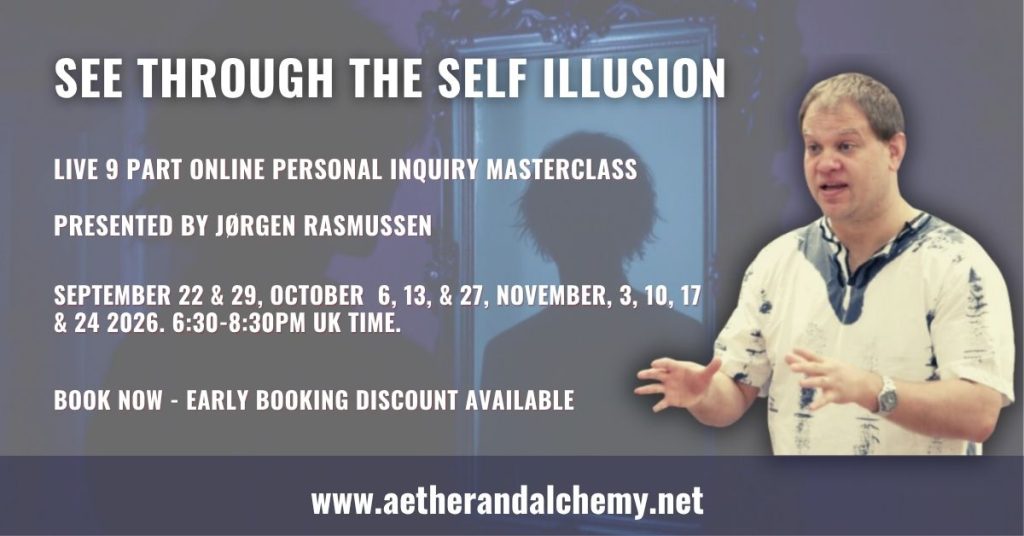
Refresher discount for returning attendees from the first cohort
What if the sense of “me” you’ve always taken for granted isn’t what you think it is?
What if anxiety, insecurity, or the drive to improve yourself are all symptoms of a deeper, mistaken assumption, that there is a thing called a self at the center of your experience?
This 9 session live online masterclass with Jørgen Rasmussen is an invitation to take a radically different kind of journey. One not aimed solely at self-development… but at seeing through the illusion of the self altogether.
“It’s one thing to intellectually realise there’s no self. It’s something else entirely to have a felt shift in perception - to see it directly, and know it in your bones.”
Rather than simply talking about spiritual ideas or psychological theories, this course is about direct, lived insight. The kind of shift that doesn’t just change your mind—but changes what you take yourself to be.
Jørgen writes:
“Most of our thinking is self referential. Most of our psychological suffering revolves around the seemingly permanent, stable, and separate self these thoughts and feelings seem to imply and revolve around.
So many of our conflicts, goals, and deeper fears have to do with self-deficiency stories. As the late psychiatrist Thomas Szasz used to say: “A friendship is two people who have agreed to uphold each others mythologies.”
But there is no such thing as a self. It’s an illusion.
It’s one thing to know this intellectually. It’s something else entirely to have an embodied realisation, and experience an actual shift in perception.
The intent behind this 9 session masterclass is to help you have an actual insight into the self being an illusion. To not only see it, but to experience an actual shift. If you know it intellectually, but can’t really feel it yet, this is the course for you."
This isn’t just another meditation course. It’s a facilitated perceptual inquiry, designed to help you:
People have their own insights and awakenings and it is possible that you might experience some or all of the following:
You'll work with a range of specific, tested approaches, among them the "Thoughts in the Room" exercise, Douglas Harding's classic "On Having No Head" inquiry, guided "Noting Gone" practice, and the mirror, screen, and wave analogies Jørgen uses to point at the same insight from different angles. If one approach doesn't land for you, another very well might.
People report different things, in their own words rather than ours:
"I have read a lot of books, purchased a lot of different courses and been to a few seminars and workshops on self-development, and I can say without hesitation that this is the best and most effective programme I have been on... Knowing it intellectually is one thing, but knowing it in an embodied way is different altogether. And no, it did not require me to go on a meditation retreat, go through dark nights of the soul, believe in some ideology (or even Jørgen himself), or sit in a cave meditating for ten years. He guided us in verifying it in our own experience. I got there in four to five sessions. This is the fastest and most practical way I know of to realise there is no self." - Kiran
In the video below Jørgen discusses the forthcoming workshop.
Many courses talk about the self. This one helps you see through it.
Rather than abstract theory or general mindfulness technique, each live session is built around real-time guided inquiry, Jørgen working directly with participants to help at least one person each session have a felt shift live. Even watching this happen for someone else can catalyse your own insight, because you get to see the troubleshooting as well as the breakthrough: what didn't land, what did, and why.
The sessions combine guided inquiry, meditation, philosophical discussion, and troubleshooting. You'll be exposed to many different angles on the same illusion, so if one approach doesn't resonate, another may.
This runs over nine weeks and is highly experiential, adapting to the people in the room. Unlike a fixed curriculum, Jørgen shapes the order and depth of each session around what's actually alive for participants, so no two runs are quite the same.
Each week typically includes:
As a bonus for this cohort, the final two sessions extend beyond personal insight into how to guide this shift in others. If you work with clients, this adds a practical dimension to the personal work:
This isn't the focus of the course, which remains squarely on your own direct experience, but if you're a coach or therapist, it's a valuable extension of what you'll already have lived through yourself.
If you were part of the first cohort, you might wonder whether coming back makes sense. A few things worth knowing:
No two runs of this course are the same. Jørgen shapes the order, depth, and angle of each session around the people in the room, so this won't be delivered word for word as it was last time, even where the core material overlaps.
Seeing through the self illusion isn't always a single, permanent event. For many people it deepens and generalises over time, into new areas of life, new situations, new edges you didn't know were still held by the old story. A second pass, with fresh questions and a different group, can surface insight the first round didn't reach.
There's also genuinely new territory this time: the final two sessions on guiding others through this shift, useful if you work with clients, weren't part of the original course.
And returning attendees join at £180, a meaningful saving on the full course price.
This masterclass is ideal for:
Please note there are real pitfalls on this journey. As the defences that maintain the self-illusion loosen, some people feel overwhelmed by emotion, or a crisis around questions of free will and agency. In past cohorts, a few participants have had genuinely uncomfortable reactions to certain exercises, tightness in the chest, shallow breathing, a felt sense of "holding on" against the grain of what's being explored. Jørgen doesn't pretend this is always smooth; the meditation and self-development world often undersells how much some people struggle with this kind of work, at least initially. This can be a genuinely destructive process for old assumptions, so it isn't for the faint of heart.
It's only recommended if you're a true truth-seeker who wants to know what's actually there, regardless of where it leads. If you're currently very emotionally unstable, it's worth addressing that first. This course assumes a reasonably settled adult psychological self, healthy boundaries, and isn't a substitute for support with unresolved trauma or crisis.
This course doesn't lean on ideas like repression, or the notion that the body "stores" trauma that must be resolved before change is possible. The evidence behind those claims is weak, and in Jørgen's experience they often do more harm than good.
Instead, the approach stays close to current research into memory, social psychology, and the role of suggestion, rather than older psychodynamic assumptions.
Nine sessions, live online via Zoom, 6:30pm to approximately 8:30pm UK time:
22nd, 29th September; 6th, 13th, & 27th October; 3rd, 10th, 17th & 24th November 2026.
Your Investment
Jørgen has worked professionally as an agent of change for over twenty-five years.
He is the author of Provocative Hypnosis and Provocative Suggestions, both widely acclaimed. John Grinder, co-creator of NLP, has said of his work: "This is the stuff of genius."
For eight years, Jørgen ran what he describes as an "impossibles practice", working with clients whom other therapists had said "couldn't be helped." He is the creator of the Psychological Illusion Model, and his work draws on hypnosis, NLP, meditation, and both Eastern and Western approaches to psychology. He is also an experienced self-defence instructor.
If you've ever felt that something's not quite right about the "I" at the centre of your life story, this course is for you.
Come ready to explore. Come ready to question. Come ready to see through.
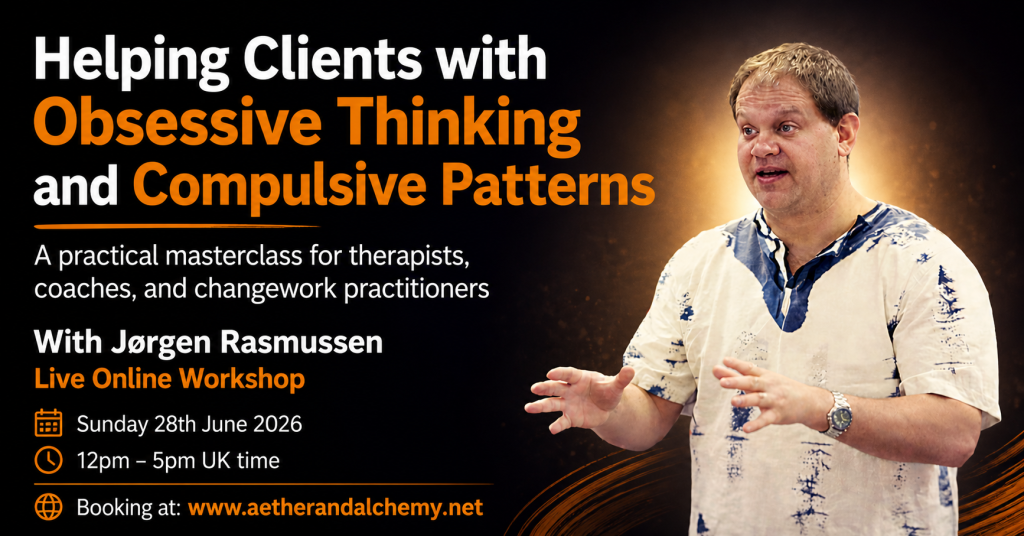
With Jørgen Rasmussen
A practical training for therapists, coaches, and changework practitioners
What if the very effort to help clients overcome compulsive thoughts is, in subtle ways, part of what keeps those thoughts in place?
Many practitioners are trained to help clients manage, challenge, or reframe their thinking. It sounds sensible. It often feels helpful in the moment.
And yet, with compulsive thinking, something different tends to happen.
With clients who experience obsessive thoughts or compulsive behaviours, the usual approaches can backfire.
Trying to control thoughts can make them feel more significant.
Trying to manage anxiety can reinforce the sense that something is wrong.
Even well-intentioned coping strategies can strengthen the very patterns they aim to resolve.
Over time, both practitioner and client can find themselves working harder without things truly shifting.
This is one reason many experienced practitioners quietly admit that they find this area challenging.
Jørgen writes:
“I have a confession: I used to dread working with clients who struggled with compulsive thoughts and rituals. And having mentored therapists and coaches for many years, I have discovered that this had been the case for them as well.
And there is a reason for that. Most approaches attempt to help the client change, manage or control either WHAT they think or HOW they think, but this often backfires as it adds even more thinking and helps mark out the thoughts as even more important. The outcome usually being that the solutions end up maintaining the problem. This is also the case with the safety rituals that people develop in an attempt to cope. They tend to reinforce the sense of threat.
What is needed is a radically different relationship to one’s thoughts and feelings.
For those who struggle with compulsive thoughts it seems as if the thoughts themselves have some sort of inherent power. An inherent power to make them act, feel, or to worry, ruminate or become hypervigilant.
It looks as if the thoughts and feelings come with a command or urge to compel behaviours and subsequent thoughts and feelings
But this is an illusion. It only seems that way. But it’s of no use to someone that it’s an illusion until they discover for themselves in an embodied way the illusory nature of thinking.
This seminar is designed to help clients see through this illusion and offers practical frameworks and strategies from the psychological illusion model as well as behavioural interventions”
You might have seen clients who:
• feel driven by thoughts that seem to carry a kind of urgency or command
• develop rituals or mental strategies to try to neutralise discomfort
• understand, intellectually, that their fears are irrational, yet still feel compelled to act
• make progress in sessions, only to find the patterns returning in daily life
And you may have noticed that the more you try to help them deal with the thoughts, the more central those thoughts seem to become.
In addition, Jorgen notes that hypnotherapists can often find these clients challenging as their busy minds often make hypnotic work more difficult.
What if the sense of compulsion is not coming from the thoughts themselves?
What if it only appears that way?
From the perspective of the Psychological Illusion Model, the power of compulsive thinking is not inherent. It is perceived.
Thoughts can seem to carry urgency, meaning, and force.
But that sense of force is created in the moment.
For many clients, there is a kind of “thought fusion”, where it looks as if certain thoughts have the power to compel action, create emotion, or pull them into rumination or hypervigilance.
But what if that power is only appearing to be there?
Until this is seen clearly, it feels real.
Once it is seen through, something fundamental shifts.
It is not enough for someone to be told that thoughts have no inherent power. The shift happens when they discover this for themselves, in a direct and embodied way.
Jørgen gives a simple example from his work:
A young man who was about to join the army struggled with stuttering.
It seemed as though certain letters, like “T” or “K”, had the power to make him stutter.
Every time he approached those words, the problem would appear.
But of course, no letter has any inherent power.
Through a series of simple experiments, he was able to see this for himself.
And as that understanding shifted, so did the pattern.
This same mechanism shows up in many different forms.
With certain thoughts
With specific situations
With particular sensations or triggers
It can look as though something external or internal has the power to compel a response.
But what if that power is only appearing to be there?
You may find it useful to hear Jørgen explain this in his own words.
In this short video, he shares a simple example that illustrates the core idea behind this approach.
The Helping OCD Clients Masterclass is designed to give you a practical, experience-based understanding of how to work with compulsive thinking in a different way.
What is needed is not more tools to change what someone thinks or how they think, but a way to guide them to a fundamentally different relationship to their thoughts and feelings.
Rather than adding more strategies on top of the problem, this training helps you guide clients towards seeing through the mechanism that creates it.
This is a hands-on, practitioner-focused training. You will:
Most approaches focus on changing thoughts or managing reactions.
This work takes a different direction.
It does not try to fight or fix thinking.
It helps clients see what thinking is and how it functions.
From that shift, change happens more naturally.
You are not applying techniques to the content of the problem.
You are helping clients see the nature of the process itself.
One of the challenges in this area is that clients can even become “compulsed” around the techniques intended to help them.
This is one reason why adding more tools is not always the answer.
For many practitioners, this represents a shift in identity as much as skillset.
From someone who manages problems to someone who facilitates insight.
This workshop is for you if:
• you are a therapist, coach, hypnotherapist, or changework practitioner
• you already work with clients and are comfortable guiding change processes
• you are open to mindbody perspectives and experiential learning
• you are interested in working beyond the limits of purely technique-driven approaches
It may not be the right fit if:
• you are looking for a strictly medical or protocol-based framework
• if you are just looking for a new tool in your toolbox and are tied to the framework you operate from. This is about guiding someone to have a different relationship to their experience.
• you prefer rigid, step-by-step methods with little flexibility
Jørgen Rasmussen has worked professionally as an agent of change for over thirty years.
He is the author of Provocative Hypnosis and Provocative Suggestions, both widely respected in the field. John Grinder (co-creator of NLP) says of his work… “This is the stuff of genius”.
His work integrates hypnosis, NLP, meditation, and both Eastern and Western psychological approaches.
He is also the originator of the Psychological Illusion Model, a framework that explores how experience is created and how insight leads to meaningful change.
Format: Live online via Zoom
Date: Sunday 28th June 2026
Time: 12pm to 5pm UK time
You do not need prior training in the Psychological Illusion Model to benefit from this workshop.
If you have ever felt that working with compulsive thinking requires something deeper than more tools or techniques, this training may offer a useful shift. If this speaks to how you want to work, you are welcome to join us.
Practitioners who train with Jørgen often describe a shift that goes beyond learning new techniques. It changes how they understand their work, and how they show up with clients.
Here is a sample of what people have said after attending his trainings:
“I will never look at change work the same way again.”
The Psychological Illusion Model has fundamentally changed how I work with clients. It’s a real game changer.
Johan
“What I experienced was truly life-changing.”
Jørgen’s work goes far beyond the intellect. His commitment to the model and the depth behind it is evident throughout.
Natasha, Clinical Psychologist
“I use this work every day with clients and achieve amazing results.”
Since starting with this approach, my practice has grown through word of mouth alone.
Peter Jakobsen, Hypnotherapist and Metacognitive Therapist
“It expanded my thinking and raised my level of change work.”
I gained practical insight into how to get better results with clients, and now feel confident applying it.
Linda Szabo
“A game changer in how I approach complex client issues.”
Clear, practical, and immediately applicable. It opened up entirely new possibilities in my work.
Thomas Wood
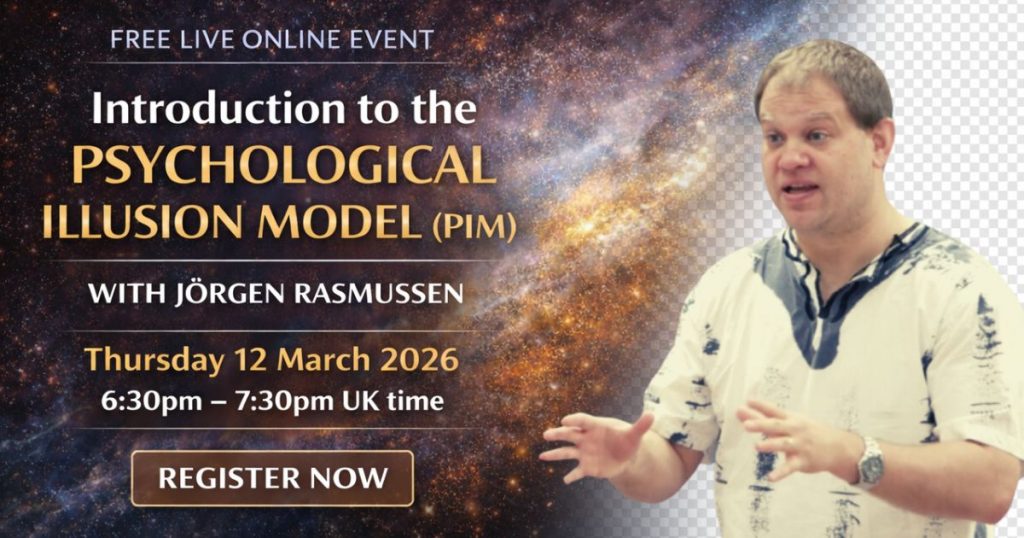
Sign Up For This Free Live Online Event here: https://aetherandalchemy.aweb.page/Introduction-to-the-Psychological-Illusion-Model--Mar-26
Many approaches to personal change focus on managing symptoms, changing thoughts, or regulating emotions.
The Psychological Illusion Model (PIM) starts from a different place.
Rather than asking “How do we fix this experience?” it explores something more fundamental:
What if much of our psychological suffering is based on a misunderstanding of thought, identity, and the sense of self itself?
In this free live session, Jørgen Rasmussen introduces the core principles behind the Psychological Illusion Model and demonstrates how insight into the illusory nature of psychological experience can lead to meaningful and lasting change.
Developed through nearly three decades of client work, the Psychological Illusion Model reflects Jørgen’s distinctive approach to understanding human experience and facilitating change.
The Psychological Illusion Model is a framework for understanding human experience that brings together:
Modern insights from psychology, hypnosis, and change work
Direct, experiential inquiry into thought, identity, and perception
A practical, non-dogmatic exploration of how the sense of “self” is created moment to moment
Rather than offering techniques or protocols, PIM points to something simpler and more radical:
When people clearly see how their experience is being created, suffering often reduces naturally, without effort or control.
In this free online event, Jørgen Rasmussen will explain how much psychological suffering is not the result of people being broken or mentally ill, but often arises from innocently falling for basic psychological illusions.
When people misunderstand the nature of their own experience, distress can feel deeply personal and inescapable. Helping them see through these misunderstandings can make a profound difference.
Jørgen will also introduce how the Psychological Illusion Model effectively turns hypnosis upside down. Rather than reinforcing suggestion, it offers a way of helping people “de-hypnotise” themselves — seeing through the assumptions that keep anxiety, low mood, chronic pain, or trauma-related patterns in place.
This session is especially relevant for therapists, coaches, counsellors, hypnotherapists, and other change-workers who want a deeper understanding of how psychological suffering is created and maintained. It will also appeal to those who are curious about approaches that go beyond techniques and symptom management, and who are interested in insight-based change, identity, and the nature of experience itself. No prior knowledge of the Psychological Illusion Model is required, just an openness to exploring a different way of understanding mind and change.
Register for free
Sign up for free on the page here:
https://aetherandalchemy.aweb.page/Introduction-to-the-Psychological-Illusion-Model--Mar-26
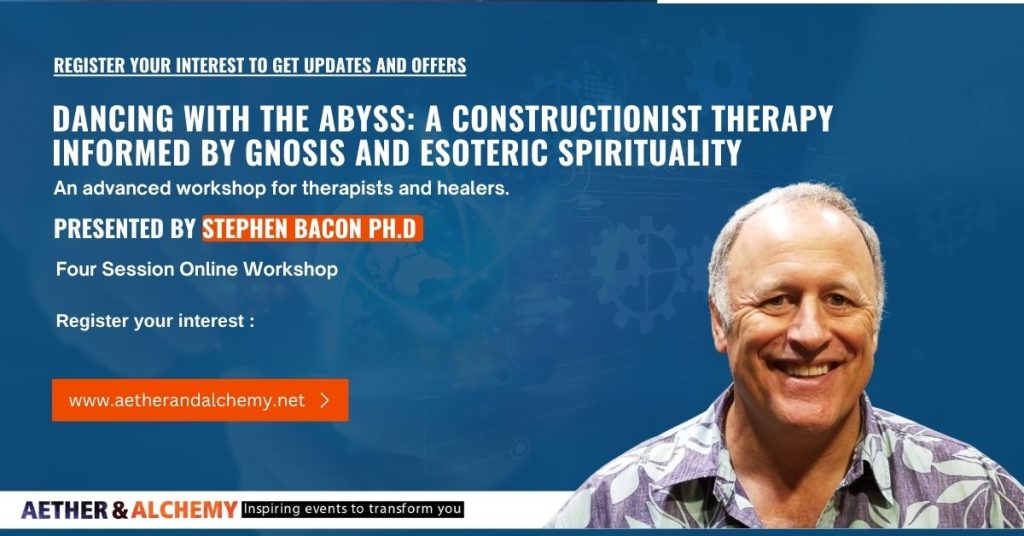
Register your interest using the form at the foot of this page to keep informed of scheduled dates and booking offers
Modern psychotherapy often presents itself as the most advanced approach to healing the mind. Yet across cultures and throughout history, healers have achieved profound change using methods that fall far outside today’s therapeutic models. Dancing with the Abyss invites practitioners to step beyond conventional assumptions and explore how meaning, belief, altered states, and deeper forms of knowing can transform the way we understand therapy and psychological change.
NB this is a workshop designed for change workers and is different to the previous workshop which focussed on personal development.
Psychotherapy prides itself on being the apex model for treating mental health issues and problems. In reality, it is a confused and limited paradigm, beset by internal contradictions and replete with outmoded, medical-model assumptions that limit, rather than enhance, outcomes. Two assumptions are particularly egregious: 1) psychotherapy works like medicine and 2) pre-existing mental health models, particularly shamanic and esoteric spiritual paradigms, can be dismissed as “merely placebo.”
In truth, every culture has included gifted healers who independently discovered the apex practices of change and transformation. These “therapeutic wizards” attributed their successes to their mastery of the “secret knowledge” or gnosis. Aldous Huxley, in his book, The Perennial Philosophy, documented the existence of such healers and explored the secret knowledge that unites all their practices.
Moreover, psychotherapy involves “changing one’s mind” and mind exists in a constructed reality that is much more fluid and amorphous than the somatic realities addressed by the medical model. Social Constructionism is the modern discipline that both grasps the nature of mind and points towards nodes of intervention and understanding.
Finally, constructivism, when taken to its limits,always encounters a “relativity problem.” When anything can be deconstructed, a healer can find themselves without a place to stand. Happily, the gnosis inherent in shamanism and mysticism can resolve this issue by ensuring that all conceptualizations, interventions, and debriefings are grounded in what Paul Tillich calls “an ultimate concern.”
In sum, this workshop examines psychotherapy from a cross-cultural, esoteric and altered states perspective. It begins by deconstructing prevailing assumptions about therapy that are both unsubstantiated and counter-productive. The contributions of constructionism and esoteric spirituality are reviewed and pragmatic contributions are highlighted. Finally, the ability to ground interventions and interpretations on a solid path is emphasized.
Background: Standard psychotherapy models are contrasted with alternative models from constructionism and esoteric spirituality. The central goal is to enhance the healer’s options and choices once they understand the tenuous and fluid nature of the therapeutic environment. A particular emphasis is placed on the additional degrees of freedom available once one understands that psychotherapeutic techniques lack inherent power.
Experiential: The workshop is based around six experiential exercises, each of which illustrates a significant aspect of secret knowledge and spirituality. Some of these interventions will be extant psychotherapeutic practices; however, the way they are introduced and explored will reveal how they relate and lead to gnosis. As part of the workshop, there will be an opportunity to present cases and review how they could evolve given a constructionist perspective.
Deconstructionism: Conventional psychotherapeutic practice is based on shared Western assumptions about what is real and what is unreal. Access to secret knowledge requires identifying assumptions that covertly mask the truth and deconstructing them. Berger and Luckmann, noted social constructionists, argue that human suffering is universal and real but that cultures construct unique explanations for the suffering. Understand how these arbitrary constructions limit interventions and lock practitioners into a minimal range of therapeutic possibilities.
Spirituality: The Perennial Philosophy and the Secret Knowledge also have the goal of personal liberation, compassion, and access to the ground of reality. This goal of realization and gnosis is paradoxically related to the freedom and apparent chaos of a fully deconstructed sense of social reality. Paul Tillich, noted existential theologian, worked to update the Perennial Philosophy for modern, Western culture and developed an approach to spirituality that is available to all individuals—from the overtly spiritual to atheists to the undefined. The workshop reviews Tillich’s work and shows how to integrate it into a modern practice of psychotherapy.
Participants: This workshop is designed for all psychotherapists and related healers (coaches, case managers, counselors and facilitators). These ancient principles are designed to fit numerous types of structured and unstructured situations and can be easily adapted to different environments.
Interventions: While specific interventions will be taught and experienced, the emphasis will always be on understanding the fluid nature of therapeutic reality and how to design rituals that maximize client fit, expectations and beliefs. Faith in the inherent power of psychotherapeutic techniques is a misconstrual and one of the chief targets for deconstruction. Healers must do something—literally make interventions—but embracers of gnosis understand that almost anything can be therapeutic if it is framed correctly.
Altered States: Constructionists are expert at understanding how cultures and individuals create realities and the assumptions at the root of such creations. As a corollary, they are equally expert in altered states, levels of consciousness that occur when the therapist helps the client move from secular space into sacred space. The appropriate utilization of altered states is a central strategy in a constructionist-informed psychotherapy.
Lasting Change: According to the Perennial Philosophy, lasting change is always based on the manifestation of a life path that addresses an authentic Ultimate Concern. Each client is on or off their own path and at different stages on their path. Effective healers recognize the nature of their own path, accept the variability in client paths, and cultivate discernment about unproductive paths. Dancing with the Abyss is a metaphor for the dynamic tension between healthy practices and the knowledge that real wisdom and inner peace lie beyond practices. Using a common gnostic metaphor, one must “kill the Buddha to become Buddha.”
In this short introduction video, Dr Stephen Bacon shares a story about Anton Mesmer relevant to Dancing with the Abyss and explains why some of the most powerful forces in psychological change may lie outside the assumptions of modern psychotherapy.
The course is structured in two distinct parts:
Part 1: The first half of the workshop covers The Perennial Philosophy, the lineage of gnosis (secret knowledge), and the problematic assumptions and misconstruals that arise from scientific Psychology’s approach to mental health and healing. Understanding the implications of constructionism for creativity and client fit are covered; finally, there is an emphasis on cultivating a consciousness of the fluidity of the past and present.
Part 2: The second half of the workshop focuses on reprogramming the map of what Kahneman calls the “fast thinking” aspect of the unconscious mind. The central relevance of altered states to change is examined and an exploration of Tillich’s path of Ultimate Concern completes the workshop.

Stephen has a background that bridges spirituality, psychology, and psychotherapy. He has worked as a psychologist in private practice for over 30 years, served as the Vice President for Program Development for Outward Bound USA. He has a Religious Studies degree, and lived in a yoga ashram for almost 6 years.
His current focus has been on exploring how psychotherapy works, the nature of social constructionism, and the connections between spirituality and therapy. He regularly conduct workshops, in the US and internationally, on these topics and have published numerous articles and a recent book, Practicing Psychotherapy in Constructed Reality: Ritual, Charisma, and Enhanced Client Outcomes.

“Despite being on the scene for nearly 150 years, psychotherapy has never has mass appeal. The majority of people who could benefit actively choose not to go. What is more, significant numbers end contact before achieving a reliable improvement in their well-being -25% of more after a single visit. Bacon’s thought provoking book not only explains why but offers a practical and effective alternative for engaging people in therapy and improving outcomes.”
- Scott D. Miller, director of the International Centre for Clinical Excellence
“This provocative book advocates the idea that the therapist is at the core of what makes psychotherapy and effective treatment. Bacon challenges prevailing wisdom by encouraging therapists to develop greater charisma if they want to maximize their impact on client mental health.”
- Michael J. Lambert, Brigham Young University
“I got 20 pages into Practicing Psychotherapy in Constructed Reality: Ritual, Charisma, and Enhanced Client Outcomes and just knew I had to contact Stephen and ask him to share this material. I am glad I did, as Stephen’s work has profound implications for people involved in, or interested in, the whole field of change work”.
- Pete Dalton – Aether and Alchemy
Register your interest to keep informed of launch offers and dates.

Book Two Jørgen Rasmussen Workshops Together
We are pleased to offer a special bundle deal for those who would like to attend both of Jørgen Rasmussen’s forthcoming workshops.
When you book The Art of Insight in Coaching and Therapy and Psychological Illusion Model Training together, you receive a discounted price compared to booking each workshop separately.
This bundle is ideal if you want a deeper, more integrated understanding of how insight happens and how psychological illusions shape human experience and change.
If you would like to attend both workshops and take advantage of the bundle discount, please book via this page.
With Jørgen Rasmussen

This workshop explores what actually creates meaningful and lasting change in coaching and therapy.
Rather than focusing on techniques or methods, Jørgen looks at how insights arise naturally when the right conditions are present. The emphasis is on understanding the psychological principles behind insight, and how practitioners can create contexts where clients see something new for themselves.
This course is particularly relevant for coaches, therapists, counsellors, and change workers who want to work in a simpler, more natural, and more effective way.
Find out more about this workshop:
https://aetherandalchemy.net/event/the-art-of-insight-in-coaching-and-therapy/
With Jørgen Rasmussen

The Psychological Illusion Model (PIM) offers a clear framework for understanding how human suffering is often maintained by mistaken perceptions rather than underlying psychological flaws.
In this training, Jørgen introduces the core principles of the model and shows how people can naturally de-hypnotise themselves from the psychological illusions behind anxiety, low mood, stress, and other common difficulties.
This workshop is not about applying techniques to clients, but about helping people see through what they are innocently misunderstanding, allowing change to happen with less effort.
Find out more about this workshop:
https://aetherandalchemy.net/event/psychological-illusion-model-training/
Taken together, these two workshops offer a coherent and complementary view of human change.
One focuses on how insight arises, the other on what is being seen through.
If you are drawn to Jørgen’s work and want a more complete understanding of his approach, the bundle provides both depth and value, along with a reduced price.
Find about each workshop at the links below
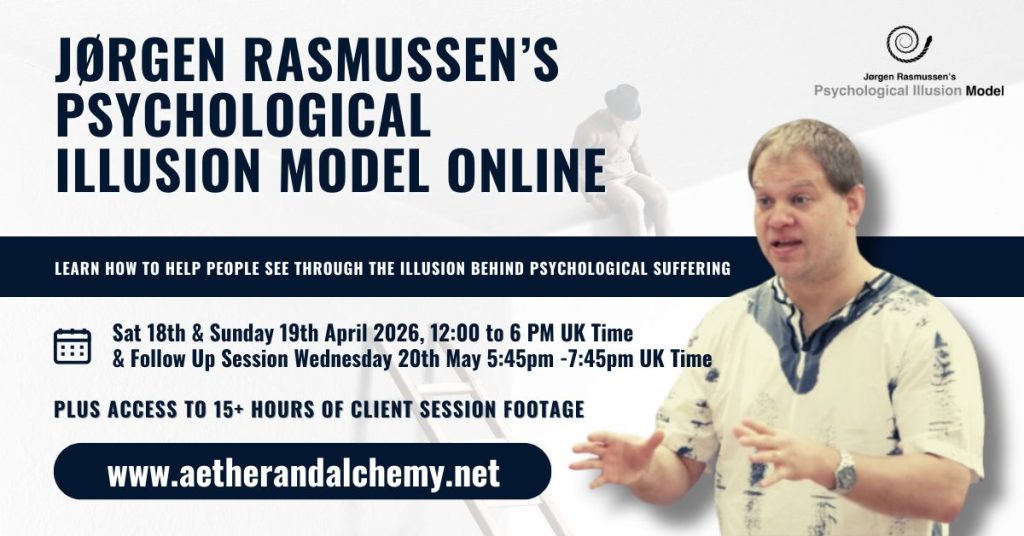
A deep training in insight-oriented changework and the art of helping people see through the illusions behind their suffering.
Main Workshop: April 18th and April 19th 2026 12pm -6pm UK time. Follow up session: 20th May 6pm -8pm UK Time. Online Live Training
Imagine walking through the desert.
You see a snake in front of you.
Your heart pounds. Your breath shortens. Your body prepares for danger.
Then you look more closely.
It is not a snake.
It is a rope.
Nothing external changed. Yet everything changed.
Your physiology settles. Your fear disappears. No coping strategy required. No belief to replace. No emotional processing. Just one thing:
You saw clearly.
The Psychological Illusion Model (PIM) is built on this principle.
What we call anxiety, depression, compulsions, phobias, chronic stress, and much psychological suffering can often be understood as variations of seeing a snake where there is a rope, deeply convincing experiences created through thought that appear to be reality itself.
It’s Less About Doing and More About Seeing
Many approaches try to fix the “snake.”
This work helps people realise it is a rope.
When that shift happens, relief can follow naturally not because something was controlled, but because something was understood.
Watch Jørgen discuss the PIM Workshop
Jørgen Rasmussen shares his methods of effective therapeutic change and how to become a more effective agent of change and in this workshop you will:
Drawing on over 25 years of therapeutic practice, Jørgen shares his approach to therapeutic change and his experiences working with difficult or ‘impossible’ clients. This has resulted in him simplifying his approach and going back to the first principles of change. This has led him to develop what he terms the ‘psychological illusion model’ of change work. He also shares his discovery about how many therapists can become more effective by getting out of their own way.
This training is not about adding more tools to your toolkit.
It is not about scripts, step-by-step methods, or treatment formats.
Instead, this work orients around:
Rather than trying to change thoughts, manage emotions, or fix behaviour, this approach explores how experience itself is constructed and how suffering often dissolves when the illusion behind it is seen.
The Practitioner’s Role Changes
You are not: forcing, correcting, or managing symptoms.
You are helping create the conditions where clients begin to see how experience is being constructed moment-to-moment.
The change comes from their insight, not your intervention.
Many of us have watched a magician perform a trick and felt slightly foolish afterwards.
We know it is an illusion
But while watching, it feels completely real.
All our attempts to figure out how the trick works only make us more confused because our solutions are based on the same blind spot that allows the illusion to work.
Psychological suffering often functions like this.
People can become absorbed in imagined worst-case scenarios and experience real anxiety.
They can become absorbed in “I’m worthless” and feel depression.
They can become absorbed in “this pain means something is seriously wrong” and magnify chronic suffering.
It is not that they are broken.
It is that they are caught in a psychological magic trick.
This training is like being invited backstage with the magician.
Through stories, demonstrations, and practical experiments, participants explore the mechanisms behind these illusions and learn how to help clients discover this for themselves.
Not by convincing them. Not by correcting them. But by helping them see.
Hypnosis can be described as becoming fully absorbed in an imagined reality.
But people often do this already.
Absorbed in imagined futures.
Absorbed in self-judgements.
Absorbed in catastrophic interpretations.
The Psychological Illusion Model explores how practitioners can create the conditions where clients begin to recognise how they have been “self-hypnotising” through thought and how this recognition itself changes their relationship with experience.
The practitioner’s role is not to fix, persuade, or override. It is to guide attention toward insight.
Jørgen describes four levels at which change work can operate:
This workshop focuses on the fourth level where shifts often occur naturally as perception changes.
This is an experiential learning environment. The teaching includes:
The aim is to help practitioners develop the sensitivity, presence, and artistry required to support insight-based change.
It Develops Change Artistry, Not Technique Accumulation
Rather than learning more methods, you develop:
• Sensitivity to psychological illusion
• Skill in framing and context creation
• Greater presence and psychological freedom as a practitioner
• The ability to work fluidly rather than mechanically
Participants receive access to 15+ hours of recorded real client sessions followed over time. These include work with:
These recordings provide a rare opportunity to observe how this model functions in real-world contexts.
An important part of the training explores something often overlooked:
The therapist’s internal state.
Many practitioners unknowingly divide attention between the client and maintaining their own self-image, managing insecurities, or trying to “get it right.” This consumes bandwidth and can reduce effectiveness.
This workshop explores how to reduce these tendencies and work from greater presence, flow, and psychological freedom.
The Psychological Illusion Model has developed through decades of client work and draws on influences including:
Jørgen continues refining the model through ongoing practice and teaching, and this training presents his most current thinking.
This workshop is suited to:
It is particularly relevant for those who feel drawn toward insight-oriented, principle-based work.
This Live Online Training includes:
Book using the form at the foot of this page.
Previous PIM participants can attend for an update and refresh at a discounted rate of £180. Also if you have attended before and you refer someone new to PIM who books on, your place is free. Contact info@aetherandalchemy.net if this is of interest.